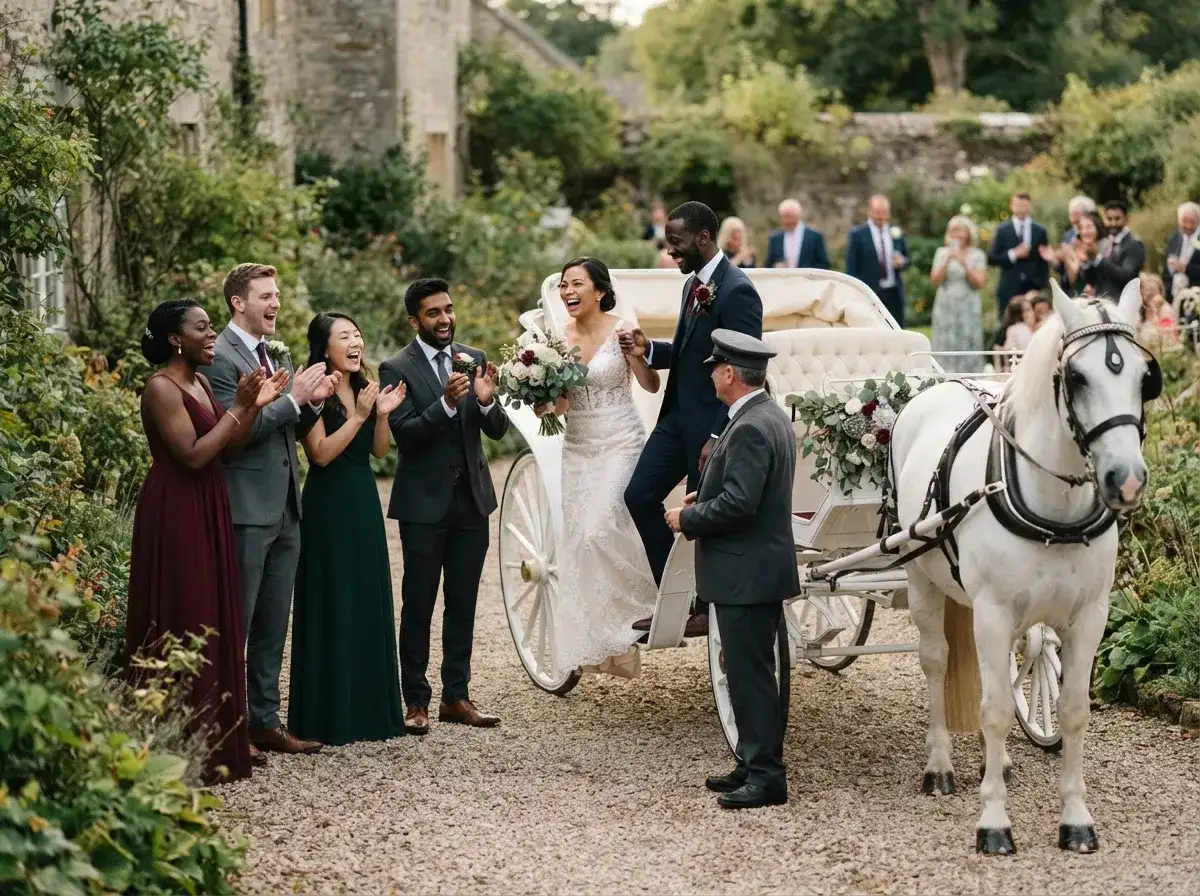
These wedding carriage entrance examples cover the moments couples choose most: a grand estate arrival, a garden ceremony approach, a golden-hour reception arrival, a first look reveal, and a city departure. Pick the one that fits your venue and timeline, confirm the route with your venue, and give the moment room in the schedule.
A carriage entrance is short. The horse rounds the corner, the music shifts, and everyone turns. Planning that minute well is what makes it feel effortless.
Which carriage entrance fits your venue?
Start with the property, not the picture. A long drive, a garden path, or a church steps all call for a different approach. Use this quick guide, then read the examples below for details.
| Venue type | Entrance that fits | Watch for |
|---|---|---|
| Historic estate or mansion | Grand arrival on the main drive | Turnaround space, parked cars |
| Garden or lawn ceremony | Soft approach to the aisle | Ground firmness, low branches |
| Downtown church or hotel | Just-married departure | Street access, staging spot |
| Farm or vineyard | First look reveal or portraits | Gates, slopes, footing |
| Ballroom reception | Golden-hour arrival at cocktails | Light, a clear lane to the door |
Your venue coordinator and the carriage team should both see the route before you finalize the timeline. That one conversation solves most surprises.
Example 1: The grand arrival at an estate
A tree-lined drive is the classic setting. Guests gather on the ceremony lawn, and the white carriage appears at the far end of the drive and approaches at a walk. Formal attire, a full floral palette, and traditional music suit this style.
Give the arrival room. Ask the venue where the carriage can turn and where it can wait out of sight. If guests must move at the last second, the moment loses its calm.
Example 2: The garden ceremony approach
A garden wedding calls for a softer entrance. A few fresh blooms or a satin ribbon on the carriage are enough. The setting does the rest.
Time the carriage to arrive as the processional music begins, while guests are seated. The bride steps down at a marked spot near the aisle. The horse and carriage stay in the background for a few photos and are then led away quietly.
Keep decorations secure and approved by the carriage team. Loose flowers can slip during the ride.
How do you time a golden-hour reception arrival?
Not every entrance happens before the ceremony. One of the most photographed wedding carriage entrance examples is the couple arriving at the reception together during the last hour of daylight. Guests gather outside with drinks, and the carriage pulls up to the door.
This works well when the ceremony site has poor carriage access but the reception property has an open lane or courtyard. It also gives the couple a quiet ride between the two parts of the day, which many say is their favorite few minutes.
To plan it, look up sunset for your date and aim for the carriage to arrive about forty minutes before. Warm light on the white carriage and the horse photographs well without rushing into darkness. Ask your photographer where they want the carriage to stop, and have the coordinator bring guests outside a few minutes early. Our wedding carriage timeline planning guide walks through the full schedule around this moment.
What does a city church departure look like?
For a downtown wedding, the exit often works better than the entrance. After the ceremony, the couple walks out to a waiting carriage while guests line the steps with ribbon wands or petals. The carriage then takes a short loop past a pretty block for portraits.
This keeps the ride short and avoids a long trip through traffic. It suits weddings in Charlotte and weddings in Raleigh, where a staging spot and a clear curb matter more than a long route.
Confirm with the venue where the carriage can wait and whether the street allows a brief stop. A short, well-planned loop photographs better than an ambitious route.
Can a carriage be part of a first look?
Yes, and it is one of the quietest ways to use one. One partner waits on an estate path or open field. The other arrives by carriage, steps down, and walks forward for the first look.
This is private rather than theatrical. It also gives your photographer carriage portraits early, so no time is taken from guests later. Choose a clean background and avoid parking areas or service doors.
How do you make a carriage entrance feel effortless?
Every graceful entrance is planned behind the scenes. These steps cover most of the work.
- Confirm the route. Walk the approach with your venue. Look for tight turns, soft ground, gates, and low branches.
- Decide who rides. The vis-à-vis carriage seats four to six. A bride with a parent feels different from a couple together, so choose on purpose. Learn more about the horses and carriages.
- Set the staging spot. The carriage should wait out of sight until the cue, with room to leave afterward.
- Brief the photographer. Tell them the arrival direction, where the carriage will stop, and which details matter to you.
- Plan for weather. The team watches the forecast and works with you to adjust the route or reschedule. Unsafe conditions pause the ride until they improve.
- Book on time. Reserve two to four weeks ahead, and know that your date is final once the approval email arrives.
Evening entrances need one more check. The path must be lit for the horse and the guests, and your photographer should be comfortable with low light.
Ready to see the carriage arrive?
Choose the entrance that matches your venue, then check whether your wedding date is open on our reservations page. Send a photo of the approach and we will help you plan the route.
Frequently asked questions
What is the most common wedding carriage entrance?
The most common choice is a ceremony arrival, where the bride or the couple rides up while guests are seated and steps down near the aisle. A just-married departure after the vows is a close second, especially at city venues with limited space.
Can the wedding party ride in the carriage too?
Yes, within the seating limit. The vis-à-vis carriage seats four to six passengers, including children. A bride often rides with a parent, or a couple rides with a flower girl and ring bearer. Tell the team who is riding when you book.
How long does a carriage entrance take?
The visible moment usually lasts a few minutes, from the carriage appearing to the bride stepping down. Plan for the team to arrive and stage well before that, and leave a short buffer so the ceremony can start calmly.
What if the venue has a gravel or grass drive?
Firm gravel and dry grass are usually fine. Very soft ground, steep slopes, or tight turns can change the route. Share photos of the approach with the team, and they will suggest a path that looks good and keeps the horse comfortable.