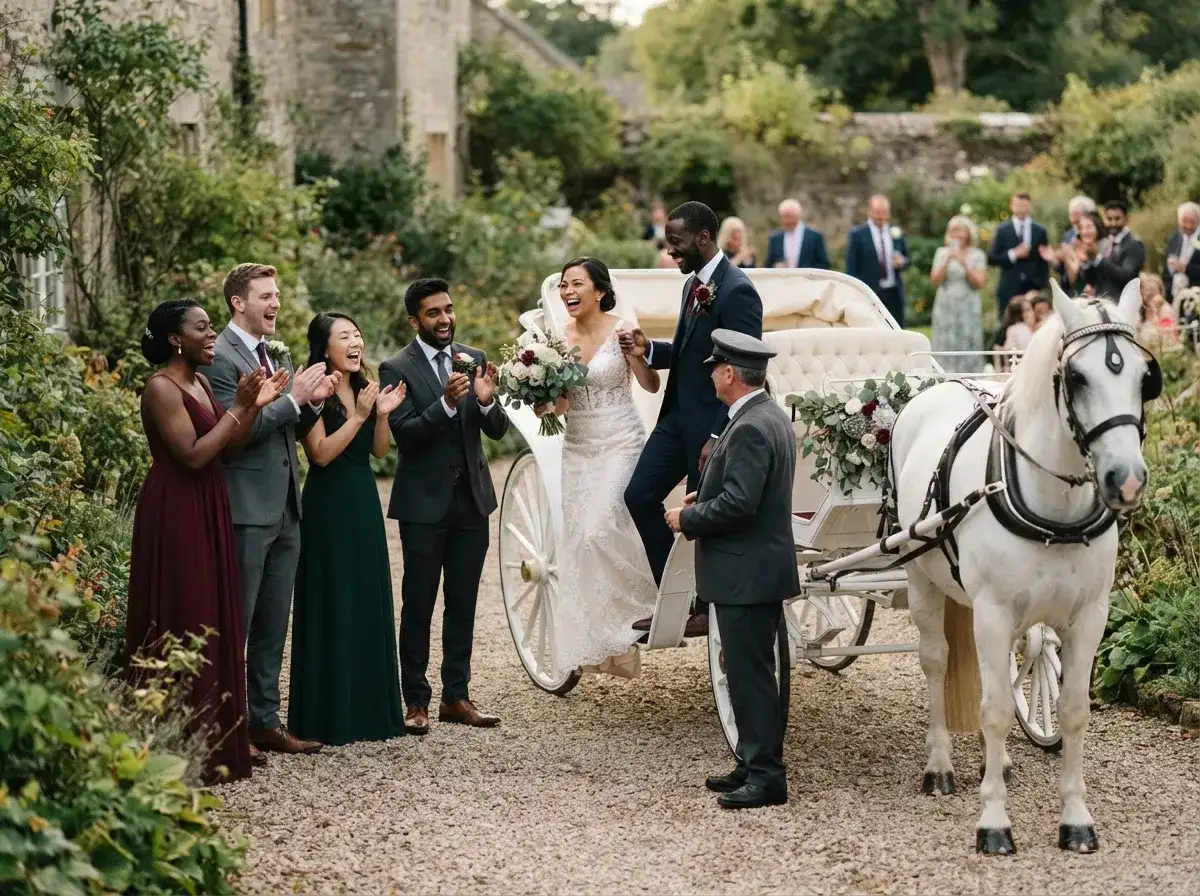
A horse drawn wedding carriage works when you make four decisions in order: pick the one moment it should create, give that moment enough time, confirm your venue can stage a horse and carriage, and book two to four weeks ahead. This guide walks through each step so the ride feels calm and unhurried on the day.
Why does a carriage change the feel of a wedding?
Most wedding transportation is practical. A carriage is emotional. Guests turn when they hear hooves, and the arrival becomes a scene rather than a step.
It also works across styles. A garden ceremony, a historic church, a downtown hotel, and a country estate can each hold a white Percheron and a classic carriage without looking out of place.
The fit matters, though. A carriage should complement the wedding, not compete with it. If your day is sharply modern, think about how the carriage will sit in the photos before you commit.
Which moment should the carriage create?
This is the first and most useful decision. The wedding carriage timeline planning guide goes deeper, but the choice comes down to three moments.
| Moment | What it feels like | What it needs |
|---|---|---|
| Ceremony arrival | A storybook first look as guests are seated | A clear approach and a place to stage out of sight |
| Private ride between ceremony and reception | A few quiet minutes alone as a married couple | A short route and a wait while the ceremony happens |
| Reception send-off | A celebratory exit as guests line up with sparklers or petals | Guests still present and a lit, safe departure path |
The arrival is public and dramatic. The private ride is personal and often the only time the couple is alone all day. The send-off is joyful and ends the night on a high note.
You can combine two, but each one adds to the reserved time. Start with the one you would miss most if it did not happen.
How much time does the carriage moment need?
Couples often underestimate this. Because the carriage looks effortless, it gets squeezed into a timeline that leaves no room to enjoy it.
Build in time for the approach, so guests actually see the carriage arrive. Build in time for boarding, because a dress and a train take a moment to settle. Build in time for photos, since your photographer will want you beside the horse, stepping up, seated together, and waving as you pull away.
For a ceremony arrival, coordinate with your planner so the carriage appears once everyone is seated. For a send-off, make sure it happens before too many guests have left.
A relaxed carriage moment reads as grace in photos. A rushed one reads as a delay. The difference is a few minutes on paper, so protect them when you draft the schedule.
What should you check with your venue?
Venue access matters more than couples expect. A beautiful front entrance in photos may not be practical for a horse in person.
Ask where the carriage can arrive, wait, and turn around. Ask about the surface: paved drives are easy, deep gravel and steep grades take more care. Ask about gates, low branches, and tight corners.
Ask whether animals are allowed on the property and where the horse can stand between moments. Some venues have a clear answer. Others have not been asked before.
Bring all of this to your quote request. The team can spot most issues early, and a clear picture of the venue makes the route and timing accurate the first time.
How do you match the carriage to your wedding style?
The classic vis-à-vis has facing seats for four to six, including children, so the couple can ride alone or with parents and attendants. Its lines are traditional and its color is white, which suits most bridal palettes.
Think about flowers and ribbon. A simple garland along the carriage side ties it to your bouquet without hiding the carriage itself. Mention any decoration when you request your date.
Think about the horse. A single white Percheron is elegant and classic. A pair makes a grander entrance and is a choice of style. Both are chosen for a gentle temperament around crowds. You can meet them on the horses and carriages page.
What should you know about booking and pricing?
Weddings are booked two to four weeks ahead. Spring and fall Saturdays fill sooner, so request your date as soon as your venue is set.
Pricing depends on event type, number of horses, duration, and distance. There is no flat rate, and each quote is personal. The pricing guide explains what moves the number before you ask for it.
Once you receive an approval email, the reservation is final. All purchases are final, so read the no refund policy before you confirm.
Weather is planned for, not feared. The team watches the forecast and works with you to reschedule or adjust the route. If conditions turn unsafe during the ride, it pauses until they improve.
When is a carriage not the right fit?
A good guide says this plainly. A carriage is not the tool for moving a large wedding party across town on a tight schedule. A shuttle does that job.
It is also a poor fit for a venue with no safe place to stage a horse, or for a day so tightly timed that the carriage would be rushed.
None of that makes it a bad choice for the right wedding. It simply means the carriage should be given a moment, a route, and a few unhurried minutes. When it has those, the result is the scene you pictured.
A horse drawn wedding carriage starts with a date and a venue. When you have both, check availability for your date and the team will help you choose the moment.
Frequently asked questions
Which wedding moment works with a horse drawn wedding carriage?
The three usual choices are the arrival at the ceremony, a private ride between ceremony and reception, and the send-off at the end of the night. Each needs a different amount of time, so pick the one that matters most and plan around it.
How much time should the carriage moment get in the timeline?
Allow time for the approach, boarding, a few portraits, and the ride itself. Dresses need arranging and photographers want more than one angle. Rushing the carriage is the most common regret, so give it breathing room in the schedule.
What should you ask your venue about a carriage?
Ask where a horse and carriage can arrive, wait, and turn around. Ask about gravel, steep drives, tight gates, and any rules about animals on the property. Bring those answers to your quote request so the route is planned correctly.
Can the wedding party ride in the carriage too?
The vis-à-vis seats up to six passengers, including children. That fits the couple with parents or a few attendants. A larger party can walk alongside for photos or meet the carriage at the destination.