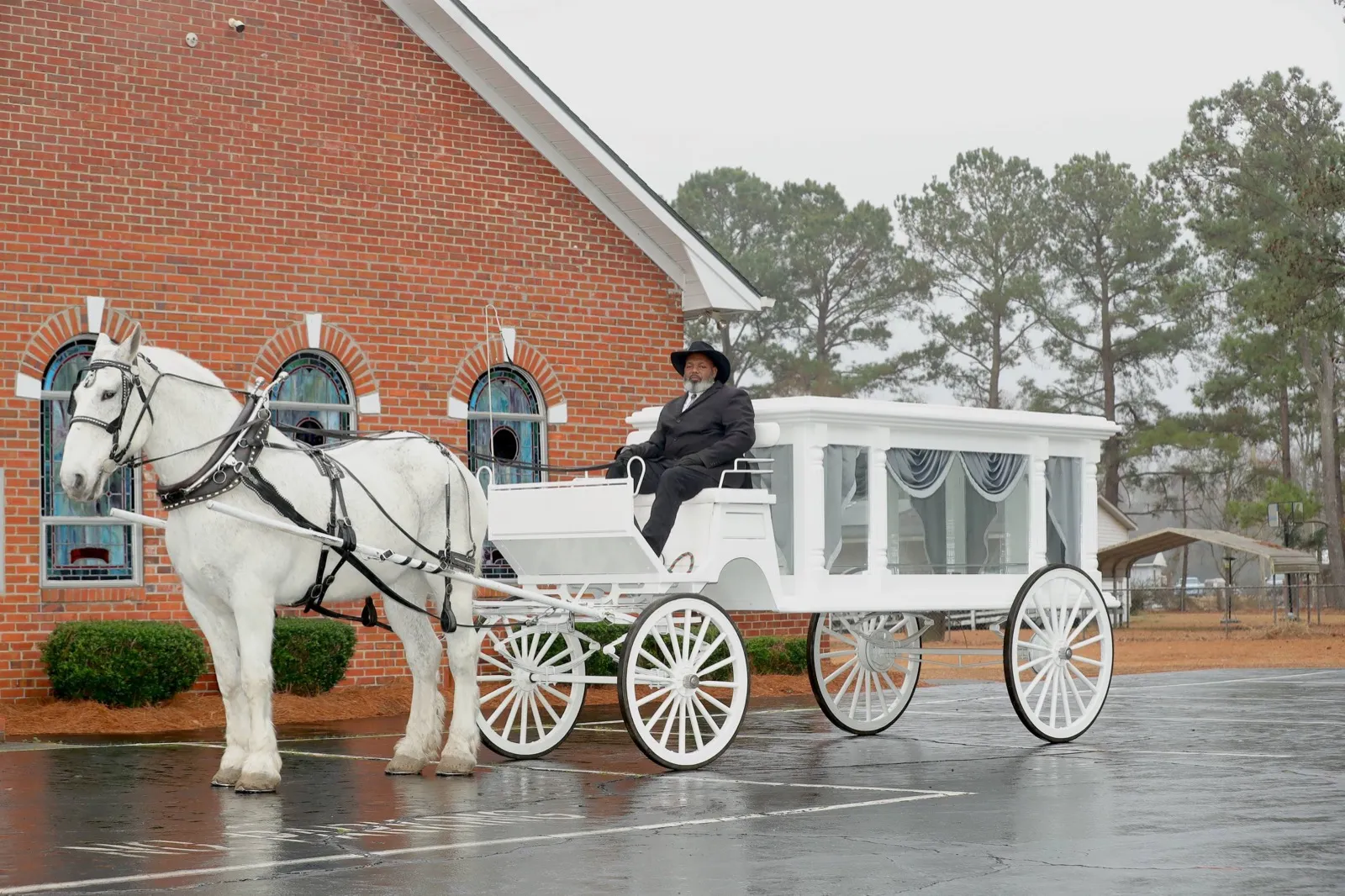
A horse drawn funeral carriage service leads the procession at a walking pace, with the casket carried in a white hearse carriage or on a military caisson drawn by gentle Percheron horses. It gives a farewell time and visible ceremony. Families arrange it with their funeral director two to four weeks ahead, and the team plans the route around it.
What is a horse drawn funeral carriage service?
It is a procession in which a horse-drawn carriage carries the casket instead of, or ahead of, a motor hearse. The horses walk. Mourners follow on foot or in cars behind.
The pace is the point. A walking procession gives family and friends time to take in the moment together rather than moving quickly from one place to the next.
The carriage is prepared for the solemnity of the day. The horses are groomed, the carriage is polished, and the driver wears a formal uniform. Everything about the presentation is meant to be quiet and dignified.
Which carriage is right for the service?
Two carriages are reserved for funerals, and each carries a different tone. You can see both on the horses and carriages page.
| Carriage | Appearance | Often chosen for |
|---|---|---|
| White hearse carriage | Enclosed, with glass sides that show the casket and flowers | Traditional funerals, church services, family processions |
| Military caisson | Flat, open carriage in the style used for state and service honors | Veterans, first responders, and those who served in uniform |
The white hearse carriage suits any service where the family wants tradition and grace. Flowers rest beside the casket and are visible through the glass.
The caisson is simpler and more formal. It is often paired with an honor guard or a flag-draped casket for a service member.
Both are drawn by white Percheron draft horses. These horses are chosen for a gentle temperament, which matters in a setting with crowds, music, and long quiet pauses.
When does a carriage procession fit a funeral?
A carriage fits when the family wants the farewell to feel deliberate. It suits a traditional funeral, a service with strong cultural or faith roots, or a celebration of life for someone who valued ceremony.
It is often chosen for veterans, community figures, and people who loved horses. It is also chosen simply because the family wants a slower, more visible goodbye than a line of cars provides.
The setting matters. A church with a short route to the cemetery, a cemetery with wide lanes, or a neighborhood the person called home all work well. A long highway distance between service and burial usually means the carriage takes a shorter symbolic leg instead.
The funeral carriage services page describes how each option can be arranged.
How does the procession work on the day?
The team arrives early and stages the carriage out of view until the service ends. The driver coordinates with the funeral director on the moment the casket comes out.
Pallbearers place the casket in the hearse carriage or on the caisson. The family gathers, and the procession begins at a walking pace.
The route is agreed in advance. It may lead from the church to the cemetery gates, through the cemetery to the graveside, or along a meaningful street before the motor hearse takes over for a longer distance.
At the graveside, the carriage stops and pallbearers carry the casket the final steps. The horses stand quietly nearby until the family is ready for them to withdraw.
Weather is watched closely. The team works with the funeral director to adjust the route or timing if needed. If conditions become unsafe during the procession, it pauses until they improve.
What should the family discuss before booking?
Clear planning in advance is what allows the day itself to feel calm. These are the points to settle with the funeral director and the carriage team.
- The carriage: white hearse carriage or military caisson
- The route, including where the procession begins and ends
- Timing, from staging before the service to withdrawal at the graveside
- Cemetery access, including lane width, gates, and where the horses can wait
- Any traditions or honors to include, such as a flag, an honor guard, or a bagpiper
- Whether photographs are welcome and where a photographer should stand
- How family members will follow, on foot or by car
Funerals are booked two to four weeks ahead. The team serves the Charlotte metro, the Triangle, and the Sandhills, with wider North Carolina and South Carolina by arrangement, so the service areas page will confirm your location.
Why do families choose a horse-drawn farewell?
People remember a funeral in fragments. A hymn. A hand on a shoulder. The flowers by the casket. A carriage procession becomes one of those lasting images.
The sound of hooves on a quiet lane has a way of settling a crowd. Conversations soften, people stand a little straighter, and the moment gets the attention it deserves.
There is comfort in ritual too. A slow procession gives everyone a shared task: to walk, to watch, and to honor the person together. For some families, it reflects faith or heritage. For others, it simply feels like the goodbye their loved one deserved.
The families who choose it tend to say the same thing afterward. It felt right.
How do you begin arranging a funeral carriage?
Start with the person, not the carriage. Ask what would have suited them and what would comfort the people gathering to say goodbye.
Then speak with your funeral director. Most are glad to coordinate the timing and route with the carriage team so you do not have to hold every detail yourself.
If it helps to read more first, the complete guide to horse-drawn funeral services goes deeper on traditions and honors.
When your family is ready, you can check a date for the service and the team will take it gently from there. There is no need to have every answer before you reach out.
Frequently asked questions
What is a horse drawn funeral carriage service?
It is a procession led by a horse-drawn hearse carriage or caisson that carries the casket at a walking pace from the service to the cemetery or along a chosen route. It replaces or leads the motor hearse and gives the farewell a slower, more visible ceremony.
What is the difference between the hearse carriage and the caisson?
The white hearse carriage is a traditional enclosed carriage with glass sides, suited to any funeral. The military caisson is the flat, open carriage used for full honors, often chosen for veterans and those who served in uniform.
Who arranges the carriage, the family or the funeral home?
Either can begin the conversation. Most families ask their funeral director to coordinate timing, route, and cemetery access with the carriage team. Booking two to four weeks ahead gives everyone time to plan the procession with care.
What happens if the weather is poor on the day?
The team watches the forecast and works with the family and funeral director to adjust the route or timing. If conditions become unsafe for horses or mourners during the procession, it pauses until they improve.