Horse-drawn funeral services carry a loved one to the service or the graveside in a hearse carriage drawn by horses, moving at a walking pace behind a uniformed driver. Families choose them for a calm, dignified procession. The team works with your funeral director on the route, the timing, and the day itself.
What is a horse-drawn funeral carriage?
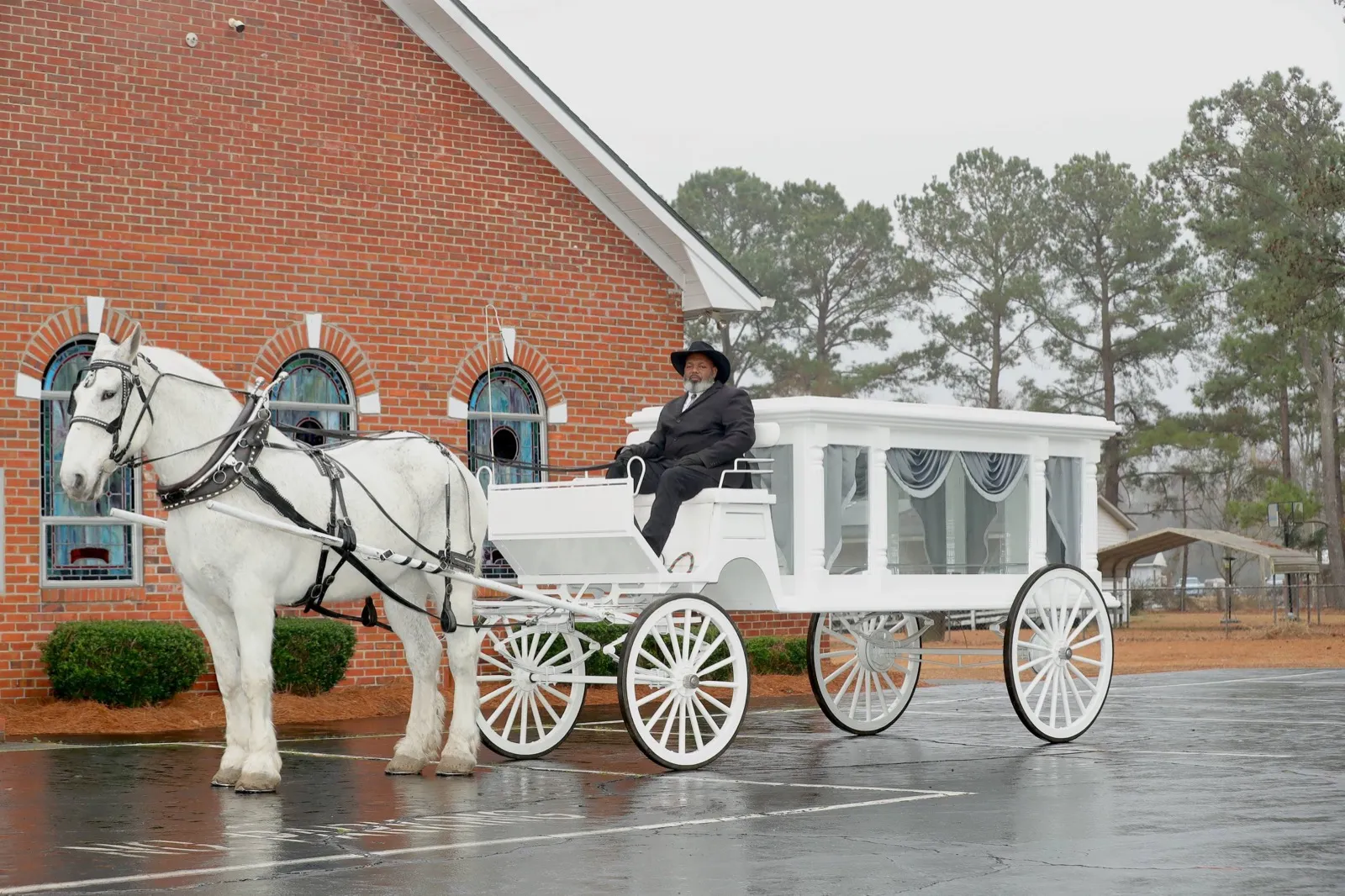
A horse-drawn funeral carriage is a hearse built to be pulled by horses rather than an engine. The casket rests inside a glass-sided body so that mourners can see it as the procession passes.
The carriage is white, and so are the horses. They are Percheron draft horses, a large, quiet breed chosen for a steady temperament in crowds and traffic. A professionally uniformed driver guides them at a slow walk.
This kind of procession is an old tradition, and it still feels right to many families today. It asks everyone to slow down for a few minutes and walk, watch, or follow behind.
Why do families choose a horse-drawn procession?
Families choose a horse-drawn procession because it changes the pace of the day. A motor hearse moves quickly and quietly. A carriage moves at the speed of a person walking, and the sound of hooves gives the procession a rhythm that everyone can follow.
That slower pace gives mourners time. Family members can walk behind the carriage, neighbors can stand at the roadside, and children can understand what is happening. The procession becomes part of the service itself.
Many families also choose it because it fits the person they are honoring. Someone who loved horses, farmed, served in the military, or simply valued tradition may have wanted this kind of farewell. Others choose it because a parent or grandparent was carried the same way.
Finally, it gives the day a visible center. Guests remember the carriage arriving at the church and the horses standing quietly at the graveside. For a family, that memory can be a comfort long after the service ends.
What is the difference between a hearse carriage and a caisson?
Two carriages are available for funerals, and they serve different kinds of services.
| White hearse carriage | Military caisson | |
|---|---|---|
| Design | Enclosed, glass-sided body that holds the casket inside | Open, flat wagon with the casket resting on top |
| Suits | Traditional, religious, and civilian services | Full military honors for veterans and service members |
| Casket | Standard casket sizes fit inside | Flag-draped casket secured on the bed |
| Look | White carriage, white horses, dark uniforms | Follows the customs of a military procession |
Your funeral director can help you decide which fits, and the team can answer questions about either one. The page on horse-drawn funeral carriage services describes both and how to arrange them.
How does the procession work on the day?
A horse-drawn funeral follows a simple order, planned in advance with your funeral director so that nothing is decided in the moment.
- The route is set. The team maps the path between the funeral home, the church, and the cemetery, choosing quiet roads and safe turns. Meaningful places, such as a family home, can be included when the distance allows.
- The carriage arrives early. The horses and driver are in place before the service ends, standing where guests can see them as they leave.
- The casket is transferred. The funeral director and pallbearers place the casket in the carriage with the same care they use for a motor hearse.
- The procession moves. The carriage leads at a walking pace. Family may follow on foot or in cars, and the driver keeps a steady rhythm.
- The graveside. At the cemetery, the casket is received, and the horses can stand quietly nearby during the committal if the family wishes.
- A quiet departure. Once the service is complete, the carriage leaves without ceremony so the family can remain.
The horse-drawn funeral carriage service guide goes into more detail on each step and on how to share your wishes with the team.
How far ahead should you arrange horse-drawn funeral services?
Two to four weeks is the ideal window for funerals and weddings alike. Funerals seldom allow that much notice, so contact the team as soon as the date and the location are known.
Share the name of the funeral home, the church or chapel, the cemetery, and the time of the service. Say whether you want the hearse carriage or the caisson, whether the horses should remain for the graveside, and whether any religious or cultural customs should shape the procession. Your funeral director can pass along most of this in a single call.
A reservation becomes final once you receive an approval email. All purchases are final, so confirm the date and the details with the funeral home before booking. The service areas page lists the Charlotte metro, Triangle, and Sandhills communities where funeral carriages are provided, with wider North Carolina and South Carolina by arrangement.
What happens if the weather turns?
Funerals cannot be moved the way a birthday can, so weather is planned for rather than hoped away. The team watches the forecast in the days before the service and talks with your funeral director about the route and timing.
Light rain does not stop a procession. The hearse carriage is enclosed, and the horses work comfortably in cool, damp weather. In heavy storms, lightning, ice, or extreme heat, the ride pauses until conditions are safe for the horses and the family. In that case, the funeral director’s motor hearse completes the trip, and the carriage rejoins when it can.
How is a horse-drawn funeral priced?
There is no set fee. The quote depends on the number of horses, how long the carriage and driver are needed, and the distance between the funeral home, the church, and the cemetery. Every quote is personal, and the pricing guide explains what goes into it.
Many families ask their funeral director to handle the request so they do not have to. That is welcome, and the team will work directly with the funeral home on the details.
When you are ready, share the date and the details on the reservation page and the team will respond with care. There is no obligation in asking, and every question will be answered plainly.
Frequently asked questions
What is a horse-drawn hearse?
A horse-drawn hearse is a carriage built to carry a casket, drawn by one or two horses and driven by a uniformed driver. It moves at a walking pace, usually between the funeral home or church and the cemetery, so mourners can follow.
How far ahead should a family arrange horse-drawn funeral services?
Two to four weeks ahead is ideal, but funerals rarely allow that much time. Contact the team as soon as the date and location are known, and the schedule will be checked right away. A reservation is final once the approval email arrives.
Can the carriage stay for the graveside service?
Yes. After the casket is received at the cemetery, the horses and carriage can stand quietly nearby during the committal. Tell the team when you request a quote so the duration and the standing place can be planned.
What is a military caisson?
A caisson is a flat, horse-drawn wagon with a flag-draped casket resting on top, used for full military honors. It is drawn by a team of horses and driven by uniformed staff, following the customs of a military funeral procession.