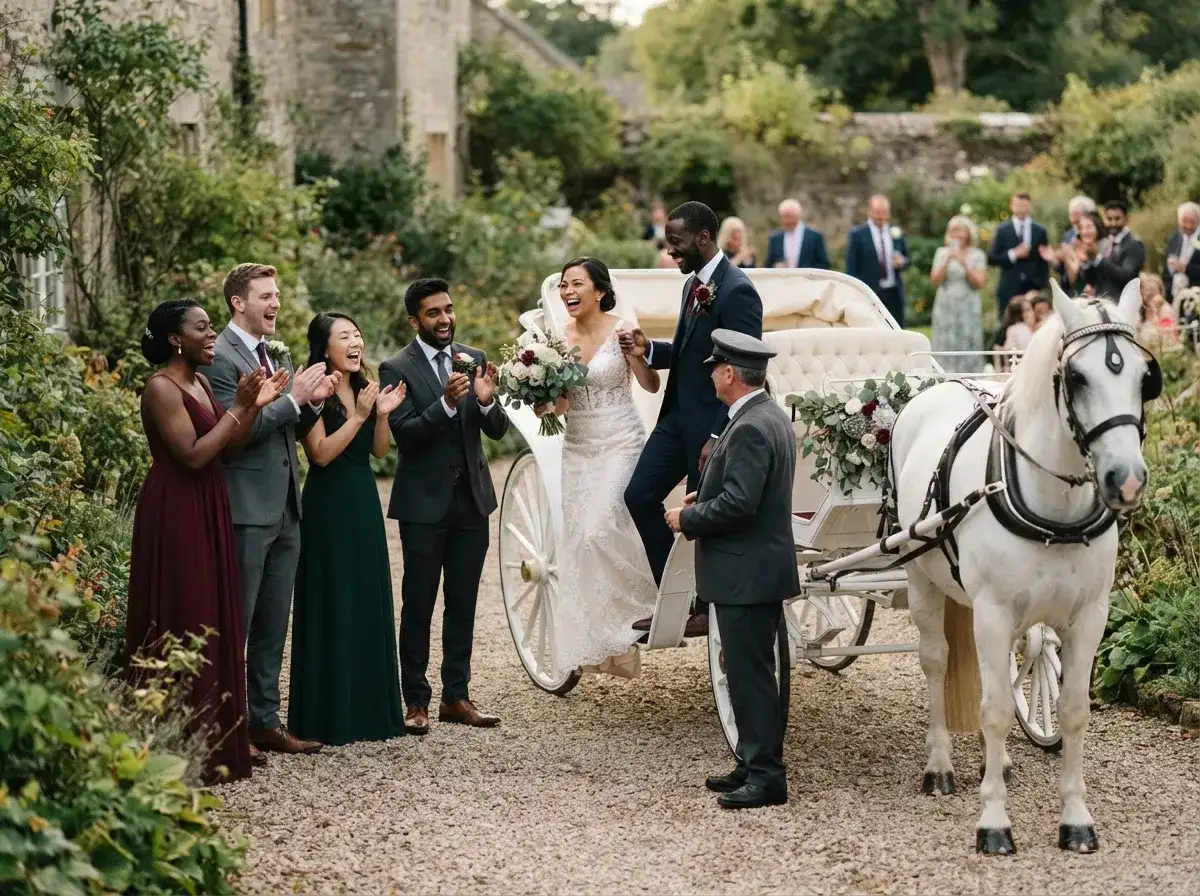
Horse and carriage wedding ideas fall into four groups: the bride's arrival at the ceremony, the couple's exit, a private ride between venues, and a portrait session with the carriage as the backdrop. Choose one or two, give each a slot in the timeline, and keep the route short.
What are the main horse and carriage wedding ideas?
A carriage can appear at almost any point in the day. These eight ideas cover the moments couples choose most often.
- The bride’s arrival. The carriage brings the bride and her parents to the ceremony door as guests are seated.
- The couple’s exit. After the vows or at the end of the reception, the newlyweds leave together at a walking pace.
- The ride between venues. A short private trip from the ceremony to a nearby reception gives the couple a few quiet minutes.
- The first look. The groom waits at the end of a drive and the carriage brings the bride to him.
- The portrait session. The carriage stands still in good light while the photographer works.
- The flower girl and ring bearer. Children arrive together in the carriage for a sweet opening to the ceremony.
- The parents’ ride. Parents or grandparents arrive by carriage as a way of honoring them.
- The staged sendoff. The couple rides a loop during golden hour and returns to the party.
You do not need more than one or two of these. Pick the moments that matter most and let the rest of the day breathe.
How do you make a carriage arrival feel grand?
A grand arrival is mostly a matter of timing and sightlines. The carriage should turn into view once guests are seated and looking toward the entrance.
Plan the pickup point a few minutes away so the horses arrive at a steady walk. A venue drive, a tree-lined lane, or a quiet street beside a church all work. The driver stops at a spot agreed on in advance, steps down, and offers a hand.
Give the bride a moment before she steps out. Let the photographer get the wide shot of the carriage, then the close shot of the door opening. A bridesmaid can gather the train while the music begins.
Keep the decoration simple. White flowers on the sides of the carriage and ribbon on the lamps are plenty. The white Percheron horses and the professionally uniformed driver complete the picture without extra staging. For a full walkthrough, read the guide on how to plan a carriage wedding entrance.
What makes a carriage exit work?
An exit works when guests can gather and the couple can leave without rushing. Ask the venue where guests may stand and where a carriage can pull up and turn.
Decide whether this is the real departure or a staged one. Many couples ride a short loop during golden hour, take their photos, and return to the dance floor. Others leave for good at the end of the night, so the route should be lit.
Check the rules on sparklers, petals, and confetti. Some venues allow them and some do not, and the horses need a calm, open path. The post on how to plan a carriage sendoff covers the details.
Which carriage suits your wedding style?
The classic vis-à-vis carriage suits nearly every wedding. Its facing bench seats hold four to six people, the open top shows off the dress, and its lines look right at a historic church, a garden, or a modern venue.
Match the styling to your day rather than the carriage itself. A formal evening wedding calls for white flowers and clean ribbon. A garden wedding can carry greenery and loose blooms. A downtown wedding often looks its most polished with no decoration at all. You can see the horses and carriages before you decide.
How do you decorate the carriage without overdoing it?
Less is more, because the horses and the carriage already draw the eye. A garland along each side, a small arrangement on the back, and ribbon on the lamps are enough.
Avoid anything that rattles, flaps, or sheds, and keep decorations away from the horses’ heads and the harness. Ask your florist to use secure ties and to finish the work before the carriage leaves for pickup. Share your plan with the team ahead of time so the driver knows what to expect. For photo-ready styling ideas, see wedding carriage photo ideas.
How do you fit the carriage into the wedding timeline?
Carriage moments need room in the schedule, because they cannot be hurried. A horse walks at about the pace of a person, and boarding a bride in a full gown takes a minute or two.
Start by choosing the moment: arrival, exit, ride between venues, or portraits. Then block out fifteen to thirty minutes around it. That covers the carriage arriving a little early, guests gathering, boarding, the ride itself, and a few minutes for photos.
Share the timeline with your planner, your photographer, and the carriage team at the same time. The planner positions guests, the photographer finds the light, and the driver plans the pickup point and the route. Tell the team about any tight turns, gravel, or hills at the venue so they can plan around them.
Wedding carriages should be reserved two to four weeks ahead, and spring and fall Saturdays fill first. The wedding carriage timeline planning guide shows sample schedules you can adapt.
Is a carriage right for every wedding?
Not every wedding needs one. If your venue has a narrow drive with no room to turn, if the ceremony and reception are far apart on busy roads, or if the schedule has no room for a slow moment, a carriage may not fit.
For couples who want a moment guests remember, though, one well-placed ride does more than a table of decorations. The team watches the forecast in the week before, and if the weather turns, they work with you to adjust the route or reschedule.
If one of these ideas belongs in your day, check your date on the reservation page and the team will follow up with a personal quote. From there, the only decision left is which moment the carriage will make.
Frequently asked questions
How is a horse and carriage used at a wedding?
Most couples use the carriage for one of three moments: the bride's arrival at the ceremony, the couple's exit from the reception, or a short private ride between the ceremony and the reception. Some also use it as a backdrop for portraits.
Can a wedding dress fit in a carriage?
Yes. The vis-à-vis carriage has an open top and facing bench seats, so a full skirt has room to spread. The driver helps with the step up, and a bridesmaid can arrange the train once the bride is seated.
Can we decorate the wedding carriage?
Yes, within reason. Fresh flowers on the sides, ribbon on the lamps, and a small sign on the back look lovely. Avoid anything that rattles, sheds, or hangs near the horses. Share your plan with the team ahead of time.
How long should the carriage ride be at a wedding?
Fifteen to thirty minutes covers most wedding rides. That leaves time for boarding, a slow loop for photos, and a calm arrival. Longer rides work when the ceremony and reception are close together on quiet roads.